Review Research
Hostinger Review 2026: Which Plan Fits a Site You Built With AI
 Anna · Designer & web developerUpdated 2026-11-06 · How we test
Hostinger plans, real renewal prices, Node.js and GitHub deploys, agency hosting and the catches. A web designer's research-based review for people who build sites with Lovable, Bolt, Claude or Cursor.
You built a landing page with Lovable, Bolt, Claude or Cursor. It works on a preview link. Now you want it on your own domain, with email that matches, and maybe a few more sites next to it. Hostinger is the name that comes up first, mostly because the price on the banner is tiny.
So is it good, or just cheap? Here is what the plans include, what you actually pay after year one, and who should pick something else.
A quick note on how I wrote this. I'm Anna, a web designer and developer. I haven't run client sites on Hostinger, so this is a research review: I read Hostinger's pricing pages, plan cards and documentation, and compared them with independent tests. Figures are from November 2026. Hosting prices move constantly, so check the checkout page before you pay. Some links here are affiliate links, and our Hostinger link gives you up to 20% off your first purchase.
Short verdict
Hostinger is a strong budget host for small sites: portfolios, landing pages, small business sites and blogs. The panel is simple, a domain, SSL and email come with the plan, and the higher plans can deploy a Node.js app straight from GitHub, which matters if your AI tool gave you a React or Next.js project.
The catches are the usual budget-host catches. The famous low price needs a 48-month prepayment, the renewal costs several times more, and support is chat only.
| Quick facts | |
|---|---|
| Best for | First websites, portfolios, landing pages, several small sites on one account |
| Not for | Heavy apps, high-traffic stores on the cheapest plan, anyone who needs phone support |
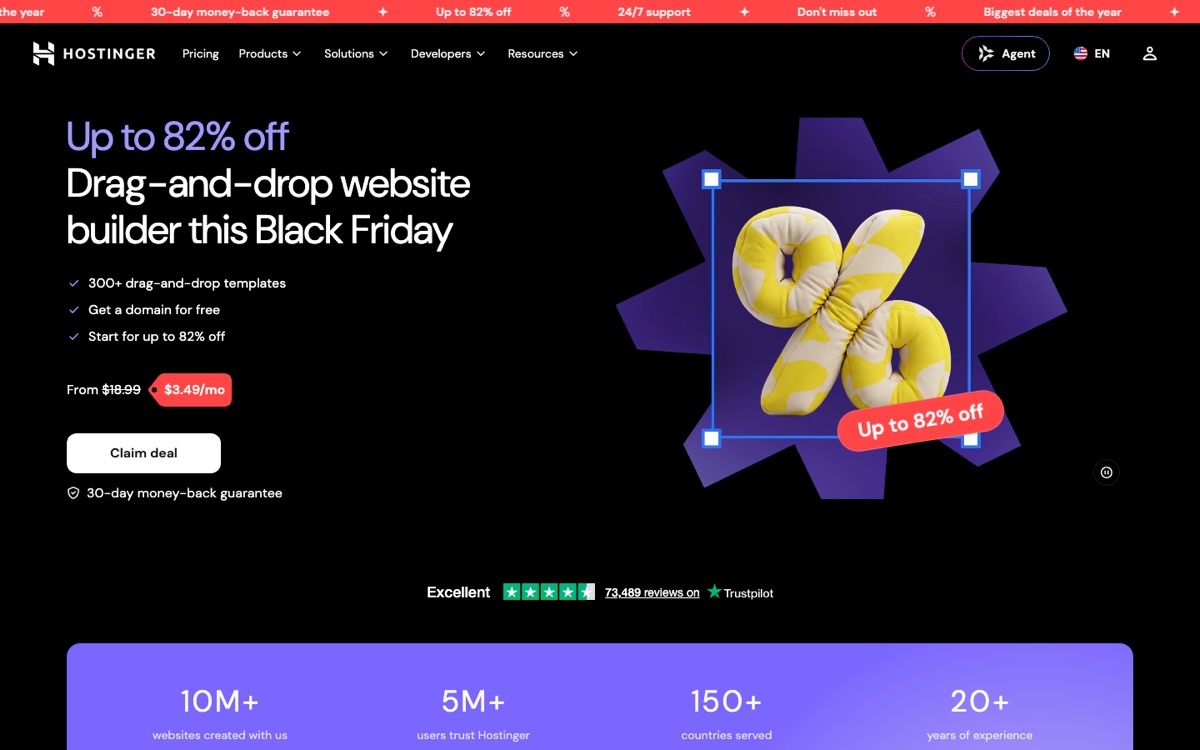
| Starting price | $1.99/mo on a 48-month term, renews at $10.99/mo |
| Free extras | Domain for the first year, SSL, email, AI website builder |
| Refund | 30-day money-back guarantee |
Plans and real prices
Hostinger shows the monthly price, but you pay the whole term upfront. Here's how that looks on the 48-month term, which is where the headline prices come from.
| Plan | Intro price | You pay today | Renews at | Sites | Storage | Backups |
|---|---|---|---|---|---|---|
| Premium | $1.99/mo | $95.52 for 48 months | $10.99/mo | 3 | 20 GB SSD | Weekly |
| Unlimited | $2.79/mo | $133.92 for 48 months | $16.99/mo | Unlimited | 50 GB NVMe | Daily |
| Cloud Startup | $7.99/mo | $383.52 for 48 months | $25.99/mo | Unlimited | 100 GB NVMe | Daily and on demand |
| Agency Startup | $29/mo | $696 for 24 months | $49/mo | 100 | 300 GB NVMe | Daily |
Prices from hostinger.com, November 2026, during their Black Friday sale.
Two things worth knowing before you choose:
- The term changes everything. The intro price is tied to the long term. Pick one year and the monthly price is higher. Pick four years and you lock in the low rate for four years, then renew at the full price.
- The free domain is free for the first year. After that you pay the normal domain renewal. The same goes for the included mailboxes: free for one year.
What you get on every plan
- Free SSL, so your address starts with https.
- A free domain for the first year on plans of 12 months or longer.
- Email on your domain: 2 mailboxes per site on Premium, unlimited on the higher plans.
- AI Builder for people who don't want to touch code, plus WordPress with one-click install.
- CDN on the higher plans, which speeds up images and video for visitors far from the server.
- A 30-day money-back guarantee.
Hosting a site made with an AI tool
This is the part most reviews skip, and it's the reason you're here.
If your tool gave you HTML, CSS and JavaScript (Claude often does, and you can export a static build from most tools), any plan works. You upload the folder through the File Manager and it's live. Premium is enough for one to three small sites.
If your tool gave you a Node.js project (React, Next.js, an Express server), look at the higher plans. Hostinger's docs describe a Node.js web app flow: you connect GitHub, pick the repository and press Deploy. After that, every push to the branch rebuilds the site automatically. The docs list this for the Business-level shared plan and the Cloud plans. Premium doesn't include it.
One catch from the docs: Node.js apps run on demand. If nobody visits for a while, the process stops, and the first visitor after a quiet period waits a bit longer. For a landing page that's fine. For an app that has to answer instantly, look at Cloud or a VPS.
Do you need hosting at all? Not always. Lovable and Bolt publish your site themselves and can connect a custom domain. A separate host makes sense when you want your own files, email on your domain and several sites in one place. Our guide on publishing a site you built with AI goes step by step.
Agency hosting for freelancers
If you build sites for clients, the Agency plans are the interesting part. Agency Startup gives you 100 sites, 300 GB of NVMe storage, daily backups and, most importantly, full isolation between sites. One client's hacked plugin doesn't touch the others. Each site gets 10 mailboxes, and there's a dedicated IP.
At $29 a month on a 24-month term ($49 on renewal), it's priced for someone with several paying clients, not for one personal site. Hostinger also lists Professional and Growth tiers above it.
Speed, uptime and support
Hostinger runs on LiteSpeed servers and advertises 99.9% uptime. Independent reviews this year mostly confirm it, with averages reported between 99.8% and 99.9%. Most testers rate the speed of small sites as good. Expect the cheapest plan to slow down once traffic grows.
Support is 24/7 live chat with no phone line. Reviews are split: plenty of people get quick answers, and a steady minority complain about slow fixes when something serious breaks. If your business can't afford an hour of downtime, factor that in.
Pros and cons
Pros
- Very low entry price on long terms.
- Domain, SSL, email and backups bundled in.
- Simple control panel that a beginner can use.
- GitHub deploys for Node.js apps on the higher plans.
- Agency plans with real site isolation for client work.
Cons
- Renewal prices are several times the intro price.
- The cheapest rate needs a 48-month prepayment.
- Chat-only support, no phone.
- Upsells at checkout: read every pre-ticked box.
- Weekly, not daily, backups on Premium.
Which plan to pick
- One portfolio or landing page from Claude or Cursor: Premium.
- A few sites, or a React/Next.js project from Lovable or Bolt: Unlimited, or Cloud Startup if you want more resources and Node.js for sure.
- An online store or a site with real traffic: Cloud Startup.
- Client sites as a freelancer or studio: Agency Startup.
- n8n, AI agents or anything that runs all day: a VPS.
Alternatives
Hostinger isn't the only sensible choice. If you want a cheap domain registrar separate from your host, or a host with phone support, compare it with the other options in our hosting and domains guide.
Bottom line
For a site you built with an AI tool, Hostinger is one of the cheapest ways to get your own domain, email and SSL in one place. Go in knowing the renewal price, choose the term on purpose, and pick the plan by what your tool exported: static files fit anywhere, Node.js apps need the higher plans.